Assessment of Methylglyoxal and Soluble Receptor Advanced Glycation End-Products (sRAGEs) in Pre-Diabetic Patients
DOI:
https://doi.org/10.22401/Keywords:
Methylglyoxal (MG), sRAGEs, Pre-diabetic patientsAbstract
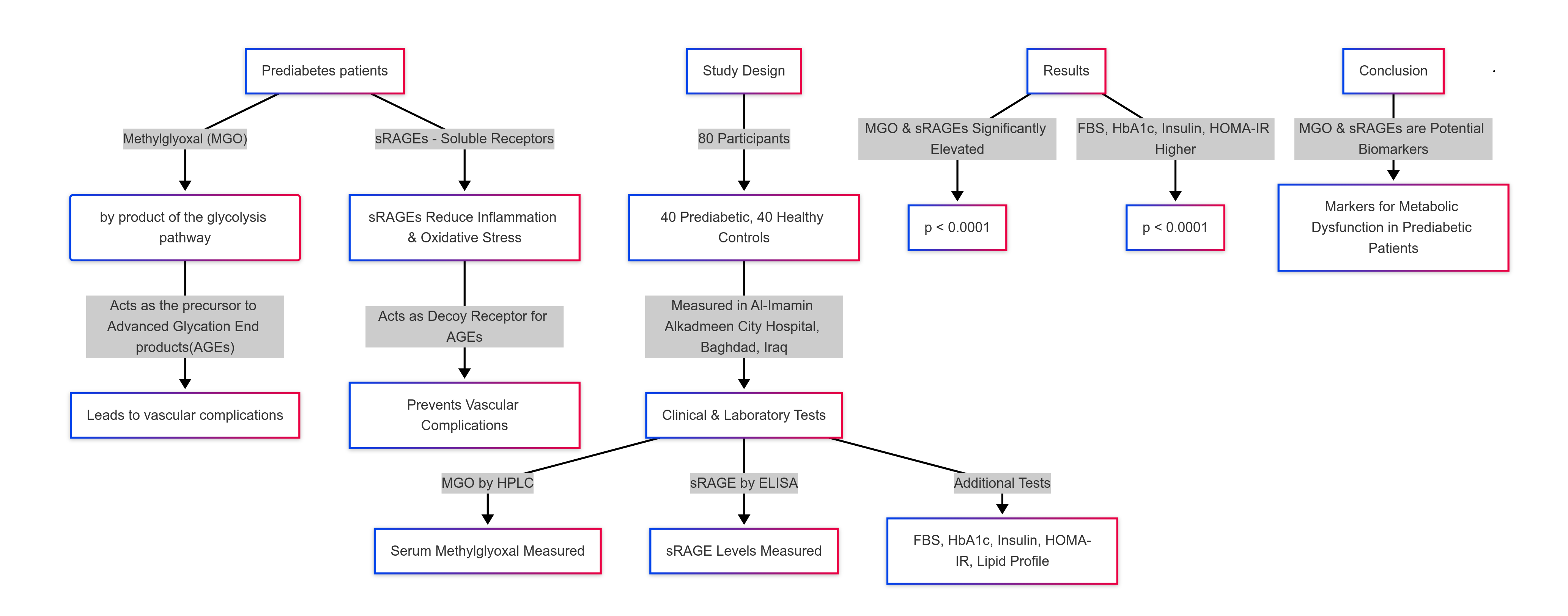
Prediabetes is a condition between normal glucose levels and increased levels of type 2 diabetes, and it is connected with a high risk of developing diabetes. Methylglyoxal is a highly reactive α-dicarbonyl compound endogenously generated naturally as a byproduct during the glycolytic pathway and is considered the precursor of an advanced glycation end product. sRAGE acting as decoy receptors help reduce inflammation, oxidative stress, and vascular complications. This study aims to measure methylglyoxal as the precursor of an AGE and its receptor in prediabetic as a biomarker for metabolic dysfunction. This study involved 80 participants, including 40 prediabetic patients and 40 healthy controls diagnosed in Al-Imamin Alkadmeen City Hospital, Baghdad, Iraq. Basic data from clinical examination and laboratory were collected for all participants. The serum methylglyoxal was measured by high-performance liquid chromatography, and soluble receptor, while advanced glycation end-products were measured by using an ELISA technique’s kit. Additional parameters were also measured, such as fasting blood glucose, HbA1c, insulin, HOMA-IR, and lipid profile. Subsequently, in prediabetic patients, methylglyoxal and sRAGE levels are significantly elevated compared to healthy controls. Moreover, FBS, HbA1c, insulin, and HOMA-IR are significantly higher in prediabetic patients (p < 0.001). Based on the findings of this research, methylglyoxal and sRAGE may serve as potential biomarkers for prediabetic patients.
References
[1] Association. A.D.; "Classification and Diagnosis of Diabetes: Standards of Medical Care in Diabetes-2024”. Diabetes Care., 47 (Supplement 1), 328, 2024
[2] Echouffo-Tcheugui, J.B.; Selvin, E.; “Prediabetes and What It Means: The Epidemiological Evidence,” Annu. Rev. Public Health., 42(1):59–77, 2020.
[3] Tabák, A. G.; Herder, C.; Rathmann, W.; Brunner, E. J.; Kivimäki, M., “Prediabetes: A high-risk state for diabetes development,” Lancet, 379, (9833), 2279–2290, 2012. doi: 10.1016/S0140-6736(12)60283-9.
[4] Bedi, D.G.; Acharya, S.; “Correlation of salivary hs-CRP With conventional cardiovascular risk markers and hba1c in prediabetic subjects,” F1000Research 13: 457,2024.
[5] Andriani, R.N.; Fitriadi, Y.; Danawati C.W.; Koesnanto, H.; Ikhsan, R.; “Analysis of Prediabetes Risk Factors at Primary Health Care Centers”. Rev. Prim. Care Pract. Educ., 5(2):52-56,2022. doi: 10.22146/rpcpe.74552
[6] Oliveira, A.L.; deOliveira, M.G.; Mónica F.Z.; Antunes, E.; “Methylglyoxal and Advanced Glycation End Products (AGEs): Targets for the Prevention and Treatment of Diabetes Associated Bladder Dysfunction?”. Biomedicines. 12(5):939,2024. doi: 10.3390/biomedicines12050939.
[7] Rabbani, N.; “Methylglyoxal and glyoxalase 1—a metabolic stress pathway-linking hyperglycemia to the unfolded protein response and vascular complications of diabetes”. Clin. Sci., 136(11):819–824, 2022.
[8] Alhujaily, M.; “Molecular Assessment of Methylglyoxal-Induced Toxicity and Therapeutic Approaches in Various Diseases: Exploring the Interplay with the
[9] Glyoxalase System”. Life. 14(2):263, 2024. doi: 10.3390/life14020263.
[10] Khalid, M.; Petroianu, G.; Adem, A.; “Advanced Glycation End Products and Diabetes Mellitus: Mechanisms and Perspectives”. Biomolecules. 12 (4): 542, 2022. doi: 10.3390/biom12040542.
[11] Legiawati, L.; “The Role of Oxidative Stress, Inflammation, and Advanced Glycation End Product in Skin Manifestations of Diabetes Mellitus”. Curr. Diabetes Rev., 18(3): 87-92, 2022.
[12] Leyane, T.S.; Jere, SW.; Houreld, NN.; “Oxidative Stress in Ageing and Chronic Degenerative Pathologies: Molecular Mechanisms Involved in Counteracting Oxidative Stress and Chronic Inflammation”. Int. J. Mol. Sci., 23(13): 7273, 2022. doi: 10.3390/ijms23137273.
[13] Fotheringham, A.K.; Bagger, J.I.; Borg D.J.; McCarthy, D.A.; Holst, J.J.; Vilsbøll T.; Knop, F.K.; et al., “Circulating Levels of the Soluble Receptor for AGE (sRAGE) during Escalating Oral Glucose Dosages and Corresponding Isoglycaemic i.v. Glucose Infusions in Individuals with and without Type 2 Diabetes”. Nutrients. 12 (10): 2928, 2020. doi: 10.3390/nu12102928.
[14] Bayarsaikhan, G.; Bayarsaikhan, D.; Lee, J.; Lee, B.; “Targeting Scavenger Receptors in Inflammatory Disorders and Oxidative Stress”. Antioxidants. 11( 5): 1–21, 2022.
[15] Hoffman, W.H.; Ishikawa, T.; Blum,J.; Tani, N.; Ikeda, T.; Artlett, C.M.; “Soluble Receptor for Glycation End-products Concentration Increases Following the Treatment of Severe Diabetic Ketoacidosis”. J. Clin. Res. Pediatr. Endocrinol. 12(2):160–167,2020.
[16] Snelson, M.; Lucut, E.; Coughlan, MT.; “The Role of AGE‐RAGE Signalling as a Modulator of Gut Permeability in Diabetes”. Int. J. Mol. Sci., 23(3): 1766, 2022.
[17] Adeshara, K.A.; Bangar, N.; Diwan, A.G.; Tupe, R.S.; “Plasma glycation adducts, and various RAGE isoforms are intricately associated with oxidative stress and inflammatory markers in type 2 diabetes patients with vascular complications”. Diabetes Metab Syndr., 16(3):102441, 2022.
[18] Schalkwijk, C.G.; Micali, L.R.; Wouters, K.; “Advanced glycation endproducts in diabetes-related macrovascular complications: focus on methylglyoxal”. Trends Endocrinol. Metab. 34(1):49–60, 2023.
[19] Stratmann, B.; “Dicarbonyl Stress in Diabetic Vascular Disease”. Int. J. Mol. Sci. 23(11):6186, 2022.
[20] Sutkowska, E.; Fecka, I.; Marciniak, D.; Bednarska, K.; Sutkowska, M.; Hap, K.; “Analysis of Methylglyoxal Concentration in a Group of Patients with Newly Diagnosed Prediabetes”. Biomedicines. 11(11): 29-68, 2023.
[21] Ali, R. Z.; Saihood, Y. D.; Abbas, A. H., Hassan, I. B.; “Estimation of Resistin and Immunoglobulins (IgA and IgM) Levels in the Serum of Iraqi Patients with Type 1 and Type 2 Diabetes Mellitus”. Iraqi J. Sci. 65(11): 6435–6443, 2024.
[22] Hadzi-Petrushev, N.; Angelovski, M.; Mladenov, M., “Advanced Glycation End Products and Diabetes”. In Obesity, Diabetes and Inflammation: Molecular Mechanisms and Clinical Management, 1st ed.; Avtanski, D.; Poretsky, L., Eds., Springer International Publishing, Cham, Switzerland, 99–127, 2023.
[23] Reyaz, A.; Alam, S.; Chandra, K.; Kohli, S.; Agarwal, S.; “Methylglyoxal and soluble RAGE in type 2 diabetes mellitus: Association with oxidative stress,” J. Diabetes Metab. Disord. 19(1): 515–521, 2020. doi:
[24] Yue, Q.; Song, Y.; Liu, Z.; Zhang, L.; Yang, L., Li, J.; “Receptor for Advanced Glycation End Products (RAGE): A Pivotal Hub in Immune Diseases”. Molecules. 27(15): 4922, 2022.
[25] Guclu, M.; Ali, A.; Eroglu, D.U.; Büyükuysal, S.O.; Cander, S.; Ocak, N.; “Serum Levels of sRAGE Are Associated with Body Measurements, but Not Glycemic Parameters in Patients with Prediabetes”. Metab. Syndr. Relat. Disord. 14(1):33–39, 2016.
[26] Huang, M.; Que, Y.; Shen, X.; “Correlation of the plasma levels of soluble RAGE and endogenous secretory RAGE with oxidative stress in pre-diabetic patients”. J. Diabetes Complications, 29(3):422–426, 2015.
[27] Mulla, I. G.; Anjankar, A.; Shinde, A., Pratinidhi, S., Agrawal, S. V., Gundpatil, D. B.; Lambe, S. D.; “Comparison of Lipid Profiles Between Prediabetic and Non-prediabetic Young Adults”. Cureus. 16(7): e65251, 2024.
[28] Bjornstad, P.; Eckel, R. H “Pathogenesis of Lipid Disorders in Insulin Resistance: a Brief Review”. Curr. Diab. Rep., 18(12): 127, 2018.
Downloads
Published
Issue
Section
License
Copyright (c) 2026 Weaam F. Hussien, Estabraq A. R. Al-Wasiti, Mahood Sh. Khudair

This work is licensed under a Creative Commons Attribution 4.0 International License.

.jpg)