A Significant Role of Soluble Programmed Death Ligand(sPDL-1) in a Progressive Infection Among Patients with Omicron SARS-CoV-2
Keywords:
Omicron, SARS-CoV-2, sPD-L1, Iraqi populationAbstract
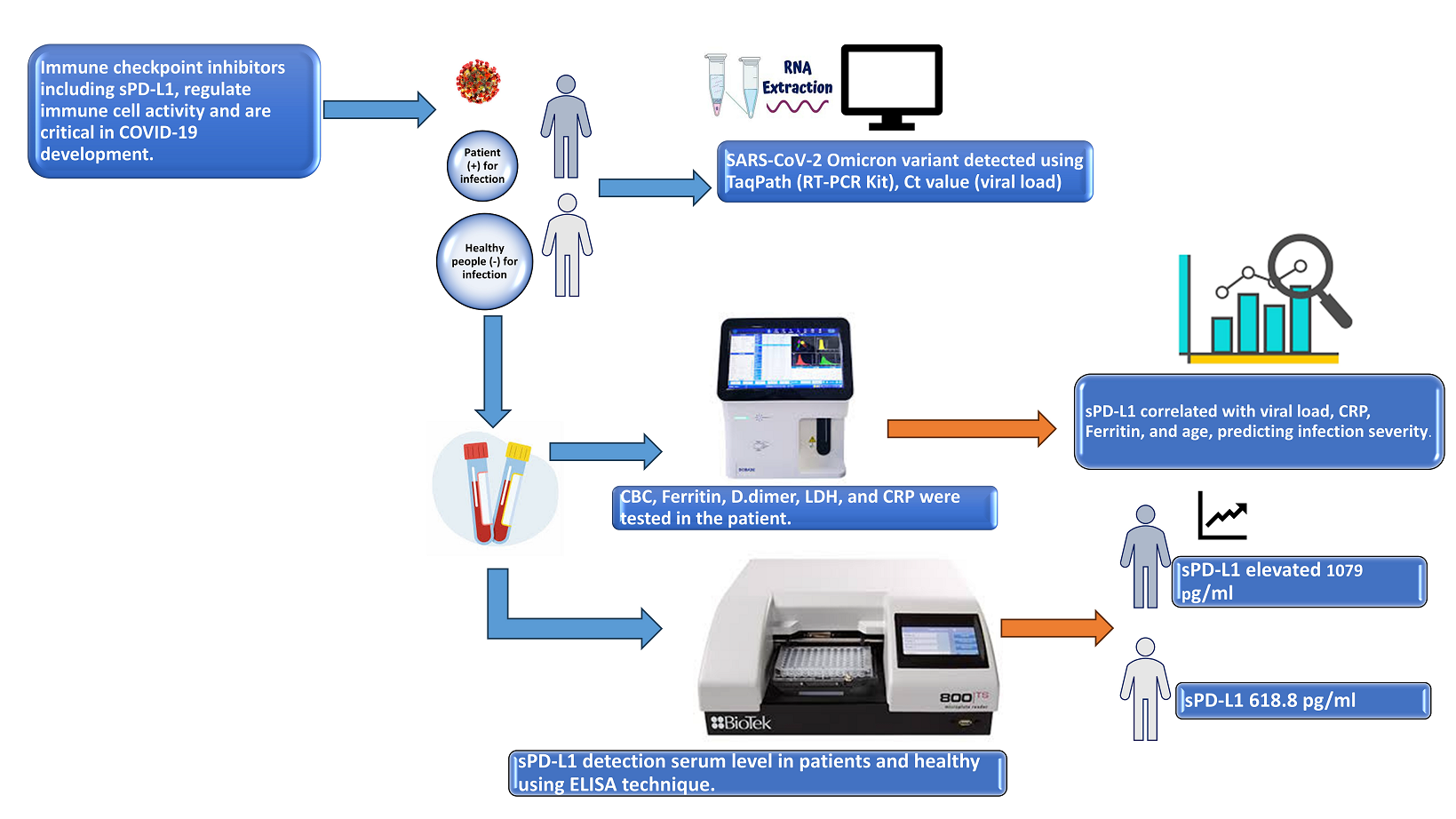
Immune checkpoint inhibitors (ICIs) are thought to be critical in developing COVID-19. Even if Omicron had a lower risk of hospitalization and mortality than other variants, some progress has been observed. Programmed cell death-1 (PD-1) is an essential ICI target because it suppresses immune cell activity and serves as a fatigue signal for immune cells. To determine the function of soluble Program Death-Ligand1 (sPD-L1) in SARS-CoV-2 (Omicron variant) infection progression and its relation with biomarkers. A case-control study (43 COVID-19 patients and 30 healthy controls) was tested for the Omicron variant infection by real-time PCR, and the biomarker and sPD-L1 were measured with an ELISA kit. Median sPD-L1 levels in infected individuals were significantly higher than in healthy controls (1079 pg/mL vs. 618.8 pg/mL; p <0.0001). According to the two-tailed Fisher exact test, 93.3 % of mild-moderate individuals had an sPDL-1 level below the median of 1079 pg/ml, indicating minimal production. In contrast, significantly high levels were found in 76.9 % of severe-critical patients. sPD-L1 levels were strongly associated with viral load (Ct value) (p < 0.0001) and increased with older age (p = 0.024) along with CRP and Ferritin levels, serving as predictive indicators for infection progression. sPD-L1 may play a role in developing infection, together with the SARS-CoV-2 Omicron variants, high viral load (low Ct value), the aged group, and severe infection, and with clinical symptoms. Additional research is needed to decrease sPD-L1-based interferon production.
References
[1] Santacroce, L.; Charitos, I.; Carretta, A.; De Nitto, DM.; and Lovero, R.; “The human coronaviruses (HCoVs) and the molecular mechanisms of SARS-CoV-2 infection". J. Mol Med. 99(1): 93-106, 2021.
[2] Sah, R.; Rais, M.; Mohanty, A.; chopra, H.; Chandran, D.; Emran, T.B.; and Dhama, K.; “Omicron (B.1.1.529) variant and its subvariants and lineages may lead to another COVID-19 wave in the world? -An overview of current evidence and counteracting strategies”. Int. J. Surg. Open. 55:100625, 2023.
[3] Zafar, T.; “The emergence of severe acute respiratory syndrome-coronavirus 2 epidemic and pandemic”. Adv.Biosens.Virus Detect. 1-18, 2022.
[4] Alkhatib, M.; “Update on SARS-CoV-2 Omicron Variant of Concern and Its Peculiar Mutational Profile”. Microbiol. Spectr. 10(2): e0273221, 2022.
[5] Salah, H.A.; Aufi, I.M.; Fadhil, H.Y.; and Alhamdani, FG.; “Human Coronavirus Species and their correlation as co-infection detected by Fast Real-Time RT-PCR”. Res. J. Pharm. Technol. 13(6): 2578-84, 2022.
[6] Doroshow, D.Y.; Bhalla, S.; Beasley, M.B.; Sholl, L.M.; Kerr M.K.; Gnjatic, S.; and Wistuba, I.I.; “PD-L1 as a biomarker of response to immune-checkpoint inhibitors”. Nat. Rev. Clin. Oncol. 18(6): 345-362, 2021.
[7] Sabbatino, F.; Conti, V.; Franci, G.; Sellitto, C.; Manzo, V.; Pagliano, P.; and Bellis, E.De.; “PD-L1 Dysregulation in COVID-19 Patients”. Front. Immunol. 12: 1-11, 2021.
[8] Chauhan, D.; Chakravarty, N.; Jeychandran, A.V.; Jayakarunakaran, A.; Sinha, S.; Mishra, R.; and Arumugaswani, V.; “In Silico Genome Analysis Reveals the Evolution and Potential Impact of SARS-CoV-2 Omicron Structural Changes on Host Immune Evasion and Antiviral Therapeutics”. Viruses. 14(11):2461, 2022.
[9] Vivarelli, S.; Falzone, L.; Torino, F.; Scandurra, G.; Russo, G.; Bordonaro, R.; Pappalardo, F.; “Immune-checkpoint inhibitors from cancer to COVID-19: A promising avenue for the treatment of patients with COVID-19 (Review)”. Int. J. Oncol. 14;58(2):145–157, 2022.
[10] Zhao, J. P.; Zhang, J.; Wang, Q.; Zhao, XI. X.; and Ji, M.; “Plasma levels of soluble programmed death ligand-1 may be associated with overall survival in nonsmall cell lung cancer patients receiving thoracic radiotherapy”. Med. (Baltimore), 96(7): e6102, 2017.
[11] Dumolard, L.; Aspord, C.; Marche, PN.; and Jlikova, Z.M.; “Immune checkpoints on T and NK cells in the context of HBV infection: Landscape, pathophysiology and therapeutic exploitation”. Front. Immunol. 28(14): 114811, 2023.
[12] Ghazzi, J.J.; Fadhil, H.Y.; and Aufi, I.M.; “Impact of SARS-COV-2 Variants on the Infection Severity among Iraqi Patients”. Iraqi J. Sci. 64(7): 4163-4172, 2023.
[13] Zhang, S.; Liu, Y.; and Wang, X.; “SARS-CoV-2 binds platelet ACE2 to enhance thrombosis in COVID-19”. J Hematol. Oncol.13(01):120, 2020.
[14] Farsalinos, K.; Barbouni, A.; and Niaura, R.; “Systematic review of the prevalence of current smoking among hospitalized COVID-19 patients in China: Could nicotine be a therapeutic option”. Intern. Emerg. Med. 15 (5): 845–852, 2020.
[15] Ali, N.; “Elevated level of C-reactive protein may be an early marker to predict risk for severity of COVID-19”. J. Med. Virol. 92, 2409–2411, 2020.
[16] Perricone, C.; “COVID-19 as part of the hyper ferritinemic syndromes: the role of iron depletion therapy”. Immunol. Res. 68(4): 213–224, 2020.
[17] Abdul Hussein, T.A.; and Fadhil, H.Y.; “Impact of inflammatory markers, dread diseases and cycle threshold (Ct)Values in COVID-19 progression”. Rev. Bionatura. 8(1):1-8,2023.
[18] Baroiu, L.; Dumitru, C.; and Iancu, A.; “COVID-19 impact on the liver”. World. J. Clin. Med. Cases. 9(16):3814–3825, 2021.
[19] Kishaba, T.; Tamaki, H.; Shimaoka, Y.; Fukuyama, H.; and Yamashiro, S.; “Staging of acute exacerbation in patients with idiopathic pulmonary fibrosis”. Lung. 192:141 9, 2014.
[20] Zhou, R.; Tardivel, A.; Thorens, B.; Choi, I.; and Tschopp, J.; “Thioredoxin-interacting protein links oxidative stress to inflammasome activation”. Nat. Immunol. 11(2):136-140, 2010.
[21] Lippi, G.; Plebani, M.; and Henry, B.M.; “Thrombocytopenia is associated with severe coronavirus disease 2019 (COVID-19) infections: a meta-analysis”. Clin. Chim. Acta. 506: 145-148, 2020.
[22] Huang, C.; Wang, Y.; Li, X.; Ren, L.; Zhao, J.; Hu, Yi.; Li.; Zhang, Li.; and Fan, G.; “Clinical features of patients infected with 2019 novel coronavirus in Wuhan, China”. Lancet. 395 (10223): 497-506, 2020.
[23] Chen, Y.; Wang, Q.; Shi, B.; Xu, P.; Hu, Z.; Bai, L.; and Zhang. X.; “Development of a sandwich ELISA for evaluating soluble PD-L1 (CD274) in human sera of different ages as well as supernatants of PD-L1+ cell lines”. Cytokine. 56(2):231–238, 2011.
[24] Schurz, H.; Salie, M.; Tromp, G.; Hoal, E.G.; Kinnear, G.J.; and Möller, M.; “The X chromosome and sex-specific effects in infectious disease susceptibility”. Hum. Genomics. 13(1):1-12, 2019.
[25] Al-Bayati, A.M.H.; Alwan, A.H.; and Fadhil, H.Y; “Potential Role of TLR3 and RIG-I Genes Expression in Surviving COVID-19 Patients with Different Severity of Infection”. Iraqi J. Sci. 63(7):2873-2883, 2022.
[26] Abed Alhussien, T.A.; and Fadhil, H.Y.; “Exploring the Role of Caspase-3 and IL32 in SARS-CoV-2 Infection among Iraqi Patients”. Iraqi J. Sci. 64 (8): 3837-3847, 2023.
[27] Ghazzi, J.J.; and Fadhil, H.Y.; “Relationship between Caspase-8 and SARS-CoV-2 Variants in a Sample of Iraqi Population”. Egypt. J. Hosp. Med. Medicine. 89: 5392- 5399, 2022.
[28] Salah, K.T.; and Fadhil H.Y.; “Clinical Characteristics of the SARS-CoV-2 Alpha, Delta, Delta plus and Omicron Variants versus the Wild Type in Iraqi Patients”. Iraqi J. Sci. 64 (9): 4329-4339, 2023.
[29] Li, J.; Zhang, Y.; and Luo, B.; “The programed death‐1/programed death ligand‐1 axis and its potential as a therapeutic target for virus‐associated tumours”. Rev. Med. Virol. 34(1) e2486, 2024.
[30] Chen, X.; Zhang, B.; Song, X.; Qian, T.; Zheng, X.; Zhang, Y.; and Wenxiong, X.U.; “Serum sPD‐1 and sPD‐L1 as HBeAg‐negative CHB patients undergoing IFN‐based therapy”. Aliment. Pharmacol. Ther. 60(5): 593-603, 2024.
[31] Tan, N.; Luo, H.; Kang, Q.; Pan, J.; Cheng, R.; Hongli, X.I.; and Chen, H.; “High levels of soluble programmed death-1 are associated with virological response in chronic hepatitis B patients after antiviral treatment”. Virus Res. 309 (6):198660, 2022.
[32] Adamski, L.J.; Starzyńska, A.; Adamska, P.; Kunc, M.; Burkiewicz, M.S.; Marvaso, G.; and Alterio, D.; “High PD-L1 Expression on Tumor Cells Indicates Worse Overall Survival in Advanced Oral Squamous Cell Carcinomas of the Tongue and the Floor of the Mouth but Not in Other Oral Compartments”. Biomedicines. 9(9):1132, 2021.
[33] Hanna, G.J.; Woo, S-B.; Li, Y.Y.; Barletta, J.A.; Hammerman, P.S.; and Lorch, J.H.; “Tumor PD-L1 expression is associated with improved survival and lower recurrence risk in young women with oral cavity squamous cell carcinoma”. Int. J. Oral Maxillofac Surg. 47(5):568-577, 2018.
[34] Satgunaseelan, L.; Gupta, R.; Madore, J.; Chia, N.; Lum, T.; Palme, C.E.; and Boyer, M.; “Programmed cell death-ligand 1 expression in oral squamous cell carcinoma is associated with an inflammatory phenotype”. Pathology. 48(6):574-580, 2016.
[35] Li, W.; Syed, F.; Richard Y.u.; Yang, J.; Xia, Y.; Relich, R.F.; and Russell, P.M.; “Soluble immune checkpoints are dysregulated in COVID-19 and heavy alcohol users with HIV infection”. Front. Immunol. 13: 833310, 2022.
[36] Cele, S.; Jackson, L.; Khoury, D.S.; Khan, K.; Gwete, T.M.; Tegally, H.; and San, J.E.; “SARS-CoV-2 Omicron has extensive but incomplete escape of Pfizer BNT162b2 elicited neutralization and requires ACE2 for infection”. medRxiv.12(8): 21267417, 2021.
Downloads
Published
Issue
Section
License
Copyright (c) 2025 Zainab M. Abbas, Hula Y. Fadhil

This work is licensed under a Creative Commons Attribution 4.0 International License.

.jpg)