Evaluating Felzenszwalb and Quick Shift Integrated Graph Neural Networks for Monkeypox Blister Segmentation
Keywords:
Monkeypox disease, Skin lesion segmentation , Spectral image clustering , GNN, RAGAbstract
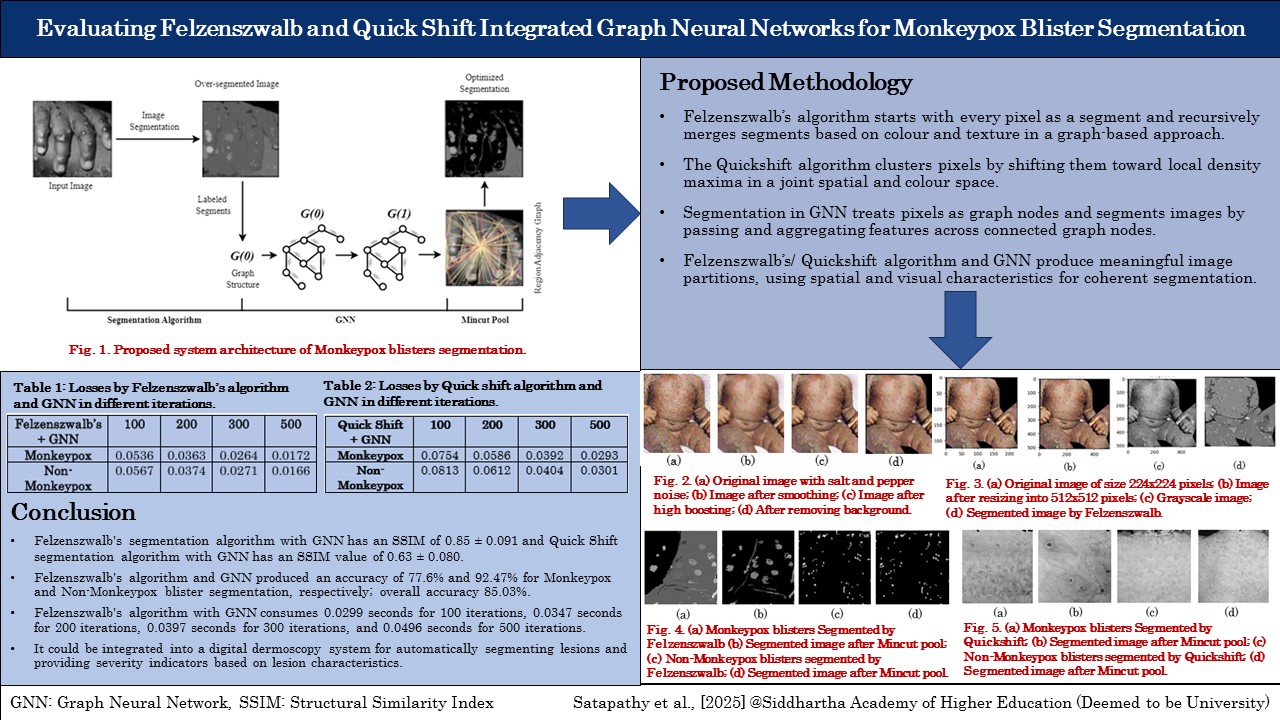
The Deep Neural Networks (DNNs) are increasingly leveraged in medical image segmentation, particularly for complex skin conditions like Monkey pox. Due to the distinctive visual features of Monkey pox, such as rashes, blisters, and scabs, distinguishing these features from those of Smallpox and Chickenpox may be difficult, thereby complicating diagnosis. We propose a comparison study with Graph Neural Networks (GNNs) integrated with both Felzenszwalb's and Quick Shift segment algorithms for Monkey pox blister segmentation. Our GNN and Felzenszwalb's algorithm combination reached a Mean Structural Similarity Index Metric (SSIM) of 0.85 ± 0.091 and an accuracy of 85.03%, outperforming the other traditional methods. Most distinctly, the combination of Felzenszwalb and GNN were more accurate in segmentation than Quick Shift, which achieved a lower performance SSIM of 0.63 ± 0.080. Correspondingly, GNN using Felzenszwalb's algorithm reached a lower average test loss of 0.0082 compared to the other approaches. This further establishes that GNNs combined with traditional segmentation methods may greatly enhance accuracy and speed of Monkey pox blister segmentation for improved diagnostic applications. It supports automated lesion analysis for early Monkey pox screening in digital dermatoscopy and teledermatology systems.
References
[1] Lowenstine, L.J.; McManamon, R.; Terio, K.A.; "Apes". In Pathology of Wildlife and Zoo Animals; Terio K.A., McAloose D. and Leger J.S., Eds.; Academic Press: USA, 375–412, 2018.
[2] Ogoina, D.; Damon, I.; Nakoune, E.; “Clinical review of human mpox”. Clin. Microbiol. Infect., 29(12): 1493-1501, 2023.
[3] Saxena, S.K.; Ansari, S.; Maurya, V.K.; Kumar, S.; Jain, A.; Paweska, J.T.; Tripathi, A.K.; et al.; "Re‐emerging human monkeypox: a major public‐health debacle". J. Med. Virol., 95(1): e27902, 2023.
[4] Sahin, V.H.; Oztel, I.; Yolcu Oztel, G.; "Human monkeypox classification from skin lesion images with deep pre-trained network using mobile application". J. Med. Syst., 46(11): 79, 2022.
[5] Ahsan, M.M.; Uddin, M.R.; Ali, M.S.; Islam, M.K.; Farjana, M.; Sakib, A.N.; Momin, K.A.; et al.; "Deep transfer learning approaches for Monkeypox disease diagnosis". Expert Syst. Appl., 216; 119483,1-20; 2023.
[6] Almutairi, S.A.; "DL-MDF-OH2: Optimized deep learning-based monkeypox diagnostic framework using the metaheuristic Harris Hawks Optimizer Algorithm". Electronics, 11(24): 4077,1-19; 2022.
[7] Okoli, G.N.; Van-Caeseele, P.; Askin, N.; Abou-Setta, A.M.; “A global systematic evidence review with meta-analysis of the epidemiological characteristics of the 2022 Mpox outbreaks”. Infection, 52(3): 901-921, 2024.
[8] Onifade, A.A.; Akindele, O.A.; Ahmad, I.; Khan, M.A.; Mat Isa, N.; Alzahrani, E.; “Modeling monkeypox transmission with a compartmental framework to evaluate testing, isolation and public awareness strategies”. Sci. Rep., 15(1): 27236, 2025.
[9] Öztürk, Ş.; Özkaya, U.; "Skin lesion segmentation with improved convolutional neural network". J. Digit. Imaging, 33(4): 958–970, 2020.
[10] Ying, Z.; You, J.; Morris, C.; Ren, X.; Hamilton, W. and Leskovec, J.; "Hierarchical graph representation learning with differentiable pooling". In: Advances in Neural Information Processing Systems, Montréal, Canada, 03-08 December; Bengio S., Wallach H., Larochelle H., Grauman K., Cesa-Bianchi N. and Garnett R., Eds.; Curran Associates, Inc.: Red Hook, NY, USA, 1-11, 2018.
[11] Wu, Z.; Pan, S.; Chen, F.; Long, G.; Zhang, C.; Yu, P.S.; "A comprehensive survey on graph neural networks". IEEE Trans. Neural Netw. Learn. Syst., 32(1): 4–24, 2020.
[12] Zhu, Y.; Xu, Y.; Yu, F.; Liu, Q.; Wu, S.; “Unsupervised graph representation learning with cluster-aware self-training and refining”. ACM Trans. Intell. Syst. Technol., 14(5); 1-21, 2023.
[13] Castro, M.A.; Thomasson, D.; Avila, N.A.; Hufton, J.; Senseney, J.; Johnson, R.F. and Dyall, J.; "Optimization of automated segmentation of monkeypox virus-induced lung lesions from normal lung CT images using hard C-means algorithm". In: Medical Imaging 2013: Biomedical Applications in Molecular, Structural, and Functional Imaging, Florida, United States, 9-14 February; Weaver J.B. and Molthen R.C., Eds.; SPIE: Bellingham, Washington, USA, 482–487, 2013.
[14] McNeil, A.J.; House, D.W.; Mbala-Kingebeni, P.; Mbaya, O.T.; Dodd, L.E.; Cowen, E.W.; Nussenblatt, V.; et al.; "Counting monkeypox lesions in patient photographs: Limits of agreement of manual counts and artificial intelligence". J. Invest. Dermatol., 143(2): 347–350, 2023.
[15] Muñoz-Saavedra, L.; Escobar-Linero, E.; Civit-Masot, J.; Luna-Perejón, F.; Civit, A.; Domínguez-Morales, M.; "A robust ensemble of convolutional neural networks for the detection of monkeypox disease from skin images". Sensors, 23(16): 7134, 2023.
[16] Ahsan, M.M.; Ali, M.S.; Hassan, M.M.; Abdullah, T.A.; Gupta, K.D.; Bagci, U.; Kaushal, C; et al.; “Monkeypox diagnosis with interpretable deep learning”. IEEE Access, 11: 81965-81980, 2023.
[17] Chakroborty, S.; “A hybrid deep learning framework for early detection of Mpox using image data”. Healthc. Anal., 7: 100396, 2025.
[18] Alhasson, H.F.; Almozainy, E.; Alharbi, M.; Almansour, N.; Alharbi, S.S.; Khan, R.U.; “A deep learning-based mobile application for monkeypox detection”. Appl. Sci., 13(23): 12589, 2023.
[19] Yadav, S.; Qidwai, T; “Machine learning-based monkeypox virus image prognosis with feature selection and advanced statistical loss function”. Med. Microecol., 19: 100098, 2024.
[20] Sitaula, C.; Shahi, T.B.; "Monkeypox virus detection using pre-trained deep learning-based approaches". J. Med. Syst., 46(11): 78, 2022.
[21] Yang, T.; Yang, T.; Liu, A.; An, N.; Liu, S.; Liu, X.; "AICOM-MP: an AI-based monkeypox detector for resource-constrained environments". Connect. Sci., 36(1): 2306962, 2024.
[22] Bamini, A.; Kumar, J.N.A.; Jayapratha, C.; Govindaprabhu, G.B.; "Revolutionizing Monkeypox Diagnosis: A Cutting-Edge Deep Learning Pipeline for Advanced Lesion Segmentation and Classification Using CoAtNet." J. Appl. Comput. Sci., 6(1): 1420-1439, 2025.
[23] Srinivasan, M.N.; Sikkandar, M.Y.; Alhashim, M.; Chinnadurai, M.; "Capsule network approach for Monkeypox (CAPSMON) detection and subclassification in medical imaging system." Sci. Rep., 15(1): 3296, 2025.
[24] Pratama, N.R.; Setiadi, D.R.I.M.; Harkespan, I.; Ojugo, A.A.; "Feature Fusion with Albumentation for Enhancing Monkeypox Detection Using Deep Learning Models." J. Comput. Theor. Appl., 2(3): 427–440, 2025.
[25] Vandana; Sharma, C.; Shah, M.A.; "MRpoxNet: An enhanced deep learning approach for early detection of monkeypox using modified ResNet50." Digit. Health, 11: 1-18, 2025.
[26] Yue, Y.; Xue, J.; Liang, H.; Li, Z.; & Wang, Y.; “MpoxMamba: A Grouped Mamba-based Lightweight Hybrid Network for Mpox Detection”. In: IEEE International Conference on Acoustics, Speech, and Signal Processing, Hyderabad, India, 06-11 April; Rao B.D., Trancoso T., Sharma G. and Mehta N.B., Eds.; IEEE: 1-5, 2025.
[27] Chaudhuri, U.; Banerjee, B.; Bhattacharya, A.; "Siamese graph convolutional network for content-based remote sensing image retrieval". Comput. Vis. Image Underst., 184: 22–30, 2019.
[28] Grattarola, D.; Zambon, D.; Bianchi, F.M.; Alippi, C.; “Understanding pooling in graph neural networks”. IEEE Trans. Neural Netw. Learn. Syst., 35(2): 2708-2718. 2022.
[29] Felzenszwalb, P.F.; Huttenlocher, D.P.; "Efficient graph-based image segmentation". Int. J. Comput. Vis., 59(2): 167–181, 2004.
[30] Zhang, S.; Ma, Z.; Zhang, G.; Lei, T.; Zhang, R.; Cui, Y.; “Semantic image segmentation with deep convolutional neural networks and quick shift”. Symmetry, 12(3): 427, 2020.
[31] Bianchi, F.M.; Grattarola, D.; Alippi, C.; "Spectral clustering with graph neural networks for graph pooling". In: International Conference on Machine Learning, Vienna, Austria, 12-18 July; Daumé III H. and Singh A., Eds.; PMLR, ML Research Press: Cambridge, MA, USA, 874–883, 2020.
[32] Zhou, S.; Xu, H.; Zheng, Z.; Chen, J.; Li, Z., Bu, J.; Wu, J.; et al.; “A comprehensive survey on deep clustering: Taxonomy, challenges, and future directions”. ACM Comput. Surv., 57(3): 1-38. 2024.
[33] Mesquita, D.; Souza, A.; Kaski, S.; "Rethinking pooling in graph neural networks". In Advances in Neural Information Processing Systems; Larochelle H., Ranzato M., Hadsell R., Balcan M.F. and Lin H., Eds.; Curran Associates, Inc.: Red Hook, NY, USA, 1-12, 2020.
[34] Chen, C.; Wu, Y.; Dai, Q.; Zhou, H.Y.; Xu, M.; Yang, S.; Han, X.; et al.; "A survey on graph neural networks and graph transformers in computer vision: A task-oriented perspective". IEEE Trans. Pattern Anal. Mach. Intell., 46(12): 10297-10317, 2024.
[35] Thorat, R.; Gupta, A.; “Transfer learning-enabled skin disease classification: the case of monkeypox detection”. Multimed. Tools Appl., 83(35): 82925-82943, 2024.
[36] Sudan, S.; “Median filter performance based on different window sizes for salt and pepper noise removal in gray and RGB images”. Int. J. Signal Process., Image Process. Pattern Recognit., 8(10): 343-352, 2015.
[37] Siddiqui, M.H.; "Application of 2D convolution in digital image processing". Asian J. Eng. Sci. Technol., 6(1): 20-23, 2016.
Downloads
Published
Issue
Section
License
Copyright (c) 2025 Ashutosh Satapathy, Duda Neelima, Naresh Dukka

This work is licensed under a Creative Commons Attribution 4.0 International License.

.jpg)