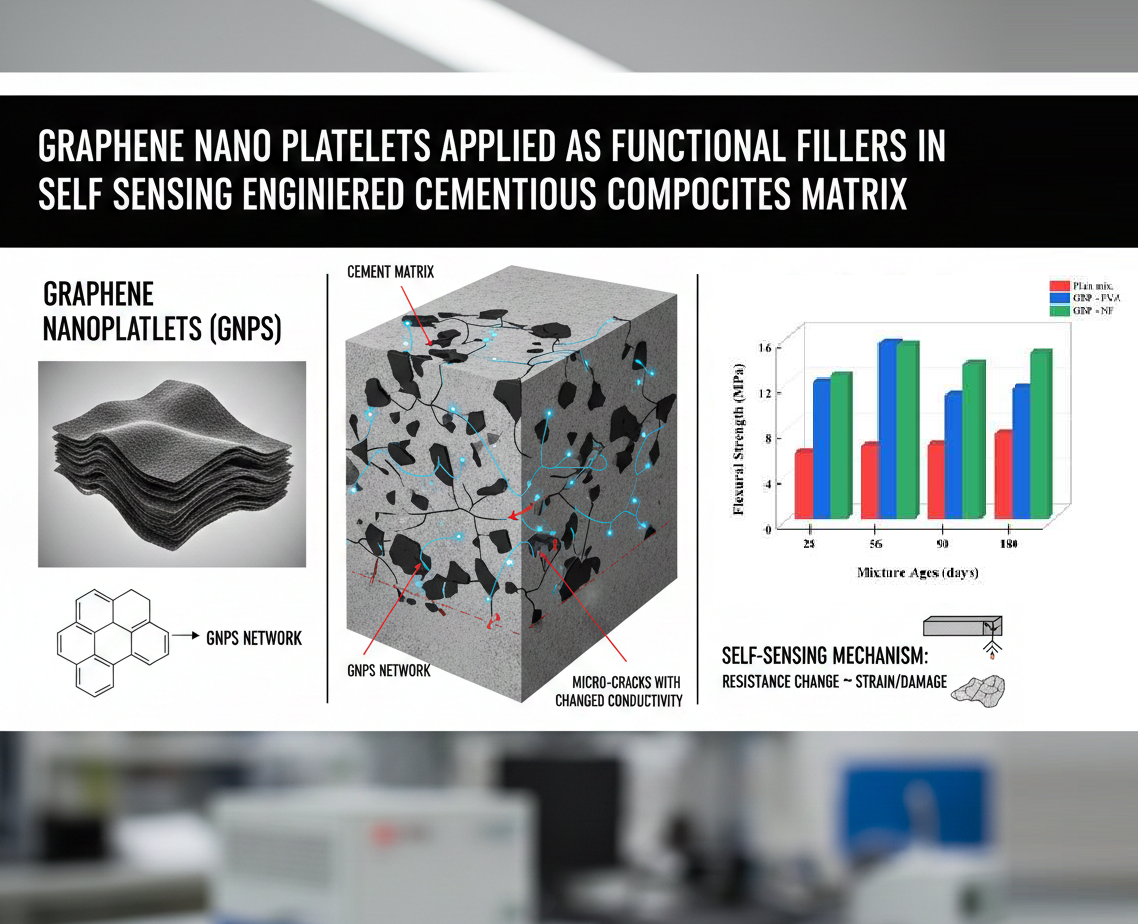
Graphene Nanoplatelets Applied as Functional Fillers in Self-sensing Engineered Cementitious Composites ECC Matrix
Keywords:
Functional Additives, Graphene Nanoplatelets (GNP), Polyvinyl Alcohol Fibers (PVA), Nylon Fibers (NF), Electrical Resistivity (ER), Self-Sensing of Damage, Fractional Change in Electrical Resistivity (FCER)Abstract
The widespread adoption of innovative cementitious composites requires proper attention to the controlled performance of structures by using these functional materials. This paper delves deeper into this concept, utilizing a conventional Engineered Cementitious Composites (ECC45) matrix that has been embedded with conductive fillers, enabling it to detect damage in a variety of loading scenarios. As functional fillers, graphene nanoplatelets (GNPs) combined with polyvinyl alcohol (PVA) and nylon (NF) fibers were used at different curing ages of 28, 56, 90, and 180 days. In an attempt to build on previous results and address some knowledge gaps, the simple matrix was incorporated with graphene nanoplatelets at a fixed concentration of 2 % by wt. of cementitious materials along with one of the reinforcement fibers (PVA) or (NF) at 2% volume fraction, which remained constant throughout the experiment. The matrices were tested for compressive strength, splitting strength, three-point flexural strength, and direct tensile strength to evaluate the innovative matrices' behavior and ability to sense damage under these types of stresses. results demonstrated a unique behavior of the samples due to the excellent behavior of GNPs, particularly during the late curing ages, and the synergistic behavior it exhibits with the reinforcement fibers, which enables entire additives to work in a balanced manner in developing the self-sensing ability in conjunction with the high efficiency of the mechanical properties against the loading conditions described in this paper.
References
[1] Abdullah, R. D.; Al-Dahawi, A.; Zghair, H. H. Mechanical Characteristics and Self-Monitoring Technique of Smart Cementitious Mixtures with Carbon Fiber and Graphite Powder as Hybrid Functional Additives. Eng. Technol. J. 40(11), 1537–1547, 2022. https://doi.org/10.30684/etj.2022.134097.1220.
[2] Al-Dahawi, A.; Öztürk, O.; Emami, F.; Yıldırım, G.; Şahmaran, M. Effect of Mixing Methods on the Electrical Properties of Cementitious Composites Incorporating Different Carbon-Based Materials. Constr. Build. Mater. 104, 160–168, 2016. https://doi.org/10.1016/j.conbuildmat.2015.12.072.
[3] Abdullah, R. D.; Al-Dahawi, A. M.; Zghair, H. H. Mechanical and Self-Sensing Properties of Cementitious Composites with Hybrid Carbon Particles/Fibers as Functional Fillers. 4th Int. Sci. Conf. Eng. Sci. Adv. Technol., 2023.
[4] Wang, Y.; Sun, S.; Zhang, L. Self-Sensing Cementitious Composites Incorporating Hybrid NGPs/CNTs/NCBs for Structural Health Monitoring. Sens. Actuat. A Phys. 357, 114365, 2023. https://doi.org/10.1016/j.sna.2023.114365.
[5] Han, B.; Sun, S.; Ding, S.; Zhang, L.; Yu, X.; Ou, J. Review of Nanocarbon-Engineered Multifunctional Cementitious Composites. Compos. Part A Appl. Sci. Manuf. 70, 69–81, 2015. https://doi.org/10.1016/j.compositesa.2014.12.002.
[6] Dong, W.; Li, W.; Tao, Z.; Wang, K. Piezoresistive Properties of Cement-Based Sensors: Review and Perspective. Constr. Build. Mater. 203, 146–163, 2019. https://doi.org/10.1016/j.conbuildmat.2019.01.081.
[7] Kim, G. M.; Nam, I. W.; Yang, B.; Yoon, H. N.; Lee, H. K.; Park, S. Carbon Nanotube (CNT) Incorporated Cementitious Composites for Functional Construction Materials: The State of the Art. Compos. Struct. 227, 111244, 2019. https://doi.org/10.1016/j.compstruct.2019.111244.
[8] Dong, W.; Li, W.; Wang, K.; Shah, S. P. Physicochemical and Piezoresistive Properties of Smart Cementitious Composites with Graphene Nanoplates and Graphite Plates. Constr. Build. Mater. 286, 122943, 2021. https://doi.org/10.1016/j.conbuildmat.2021.122943.
[9] Mahdi, S. A.; et al. Chemical Structure Modification of Polystyrene (PS): A Short Review. Al-Nahrain J. Sci. 27(5), 58–69, 2024. https://doi.org/10.22401/anjs.27.5.07.
[10] Mussa, F.; Al-Dahawi, A.; Banyhussan, Q. S.; Baanoon, M. R.; Shalash, M. A. Carbon Fiber-Reinforced Asphalt Concrete: An Investigation of Some Electrical and Mechanical Properties. IOP Conf. Ser. Mater. Sci. Eng. 737, 012122, 2020. https://doi.org/10.1088/1757-899X/737/1/012122.
[11] Al-Dahawi, A. M.; Mohammed, A.; Banyhussan, Q. S. Effect of Adding Additional Carbon Fiber on Piezoresistive Properties of Fiber Reinforced Concrete Pavements under Impact Load. Eng. Technol. J. 39(12), 1771–1780, 2021. http://doi.org/10.30684/etj.v39i12.1942.
[12] Ghadhban, D.; Joni, H. H.; Al-Dahawi, A. M. Carbon Fiber-Based Cementitious Composites for Traffic Detection and Weighing In Motion. Eng. Technol. J. 39(8), 1250–1256, 2021. https://doi.org/10.30684/etj.v39i8.1875.
[13] Hameed, I. T.; Al-Dahawi, A. Electro-Mechanical Properties of Functional Fiber-Based Rigid Pavement under Various Loads Applied on a Large-Scale In-Situ Section. E3S Web Conf. 427, 03033, 2023. https://doi.org/10.1051/e3sconf/202342703033.
[14] Chung, D. D. L. Carbon Materials for Structural Self-Sensing, Electromagnetic Shielding and Thermal Interfacing. Carbon 50(9), 3342–3353, 2012. https://doi.org/10.1016/j.carbon.2012.01.031.
[15] Xu, G.; Du, S.; He, J.; Shi, X. The Role of Admixed Graphene Oxide in a Cement Hydration System. Carbon 148, 141–150, 2019. https://doi.org/10.1016/j.carbon.2019.03.072.
[16] Hasan, A. A.; Al-Mashhadani, M. H.; Al-Dahhan, W. H.; Yusop, R. M.; Yousif, E. A. Recent Approaches to Modify Poly(vinyl chloride) Chemical Structure. Al-Nahrain J. Sci. 25(3), 8–15, 2022. https://doi.org/10.22401/anjs.25.3.02.
[17] Li, W.; Dong, W.; Shen, L.; Castel, A.; Shah, S. P. Conductivity and Piezoresistivity of Nano-Carbon Black (NCB) Enhanced Functional Cement-Based Sensors Using Polypropylene Fibres. Mater. Lett. 270, 127736, 2020. https://doi.org/10.1016/j.matlet.2020.127736.
[18] Yang, H.; Cui, H.; Tang, W.; Li, Z.; Han, N.; Xing, F. A Critical Review on Research Progress of Graphene/Cement Based Composites. Compos. Part A Appl. Sci. Manuf. 102, 273–296, 2017. https://doi.org/10.1016/j.compositesa.2017.07.019.
[19] Sedaghat, A.; Ram, M. K.; Zayed, A.; Kamal, R.; Shanahan, N. Investigation of Physical Properties of Graphene-Cement Composite for Structural Applications. Open J. Compos. Mater. 4(1), 12–21, 2014. https://doi.org/10.4236/ojcm.2014.41002.
[20] Pang, S. D.; Gao, H. J.; Xu, C.; Quek, S. T.; Du, H. Strain and Damage Self-Sensing Cement Composites with Conductive Graphene Nanoplatelet. In Sensors and Smart Structures Technologies for Civil, Mechanical, and Aerospace Systems 2014; SPIE: Bellingham, WA, USA, 2014; Vol. 9061, pp. 546–556.
[21] Saafi, M.; et al. Graphene/Fly Ash Geopolymeric Composites as Self-Sensing Structural Materials. Smart Mater. Struct. 23, 065006, 2014. https://doi.org/10.1088/0964-1726/23/6/065006.
[22] Chuah, S.; Pan, Z.; Sanjayan, J. G.; Wang, C. M.; Duan, W. H. Nano Reinforced Cement and Concrete Composites and New Perspective from Graphene Oxide. Constr. Build. Mater. 73, 113–124, 2014. https://doi.org/10.1016/j.conbuildmat.2014.09.040.
[23] Iraqi Standard Specification. Iraqi Standard Specification No. 5, for Portland Cement; Central Organization for Standardization and Quality: Iraq, 1984.
[24] ASTM-C618. Standard Specification for Coal Fly Ash and Raw or Calcined Natural Pozzolan for Use in Concrete; ASTM Int.: West Conshohocken, PA, USA, 2014; https://doi.org/10.1520/c0618-12a.
[25] ASTM C494/C494M. Standard Specification for Chemical Admixtures for Concrete. Annu. Book ASTM Stand. 2019, 04.
[26] Abdullah, R.; Al-Dahawi, A.; Zghair, H. Mechanical Characteristics and Self-Monitoring Technique of Smart Cementitious Mixtures with Carbon Fiber and Graphite Powder as Hybrid Functional Additives. Eng. Technol. J. 40(11), 1537–1547, 2022. http://doi.org/10.30684/etj.2022.134097.1220.
[27] Abdullah, R. D. Mechanical and Self-Sensing Properties of Cementitious Pavement Composites Enhanced with Hybrid Electrically Conductive Materials; University of Technology: 2022.
[28] Al-Dahawi, A. M.; Abdullah, R. D.; Joni, H. H. An Investigation of Self-Sensing and Mechanical Properties of Smart Engineered Cementitious Composites Reinforced with Functional Materials. Open Eng. 14(1), 2024. https://doi.org/10.1515/eng-2022-0568.
[29] Al-Dahawi, A. M. Effect of Curing Age on the Self-Sensing Behavior of Carbon-Based Engineered Cementitious Composites (ECC) under Monotonic Flexural Loading Scenario. MATEC Web Conf. 162, 2018. https://doi.org/10.1051/matecconf/201816201034.
[30] Sarwary, M. H.; et al. Self-Sensing of Flexural Damage in Large-Scale Steel-Reinforced Mortar Beams. ACI Mater. J. 116(4), 2019. https://doi.org/10.14359/51715581.
[31] Yıldırım, G.; Öztürk, O.; Al-Dahawi, A.; Ulu, A. A.; Şahmaran, M. Self-Sensing Capability of Engineered Cementitious Composites: Effects of Aging and Loading Conditions. Constr. Build. Mater. 231, 2020. https://doi.org/10.1016/j.conbuildmat.2019.117132.
[32] Şahmaran, M.; Li, V. C. Durability of Mechanically Loaded Engineered Cementitious Composites under Highly Alkaline Environments. Cem. Concr. Compos. 30(2), 72–81, 2008. https://doi.org/10.1016/j.cemconcomp.2007.09.004.
[33] Sahmaran, M.; Yildirim, G.; Erdem, T. K. Self-Healing Capability of Cementitious Composites Incorporating Different Supplementary Cementitious Materials. Cem. Concr. Compos. 35(1), 89–101, 2013. https://doi.org/10.1016/j.cemconcomp.2012.08.013.
[34] ASTM-C109/C109M. Standard Test Method for Compressive Strength of Hydraulic Cement Mortars (Using 2-in. or [50-mm] Cube Specimens); ASTM Int.: West Conshohocken, PA, USA, 2005.
[35] ASTM-C496–96. Standard Test Method for Splitting Tensile Strength of Cylindrical Concrete Specimens; ASTM Int.: West Conshohocken, PA, USA, 2017. https://doi.org/10.1520/C0496-96.
[36] ASTM-C348–02. Standard Test Method for Flexural Strength of Hydraulic-Cement Mortars; ASTM Int.: West Conshohocken, PA, USA, 2002.
[37] ASTM-C307−03. Standard Test Method for Tensile Strength of Chemical-Resistant Mortar, Grouts, and Monolithic Surfacings; ASTM Int.: West Conshohocken, PA, USA, 2012. https://doi.org/10.1520/c0307-03r12.
[38] Al-Dahawi, A.; et al. Electrical Percolation Threshold of Cementitious Composites Possessing Self-Sensing Functionality Incorporating Different Carbon-Based Materials. Smart Mater. Struct. 25(10), 2016. http://dx.doi.org/10.1088/0964-1726/25/10/105005.
[39] Al-Dahawi, A.; Yıldırım, G.; Öztürk, O.; Şahmaran, M. Assessment of Self-Sensing Capability of Engineered Cementitious Composites within the Elastic and Plastic Ranges of Cyclic Flexural Loading. Constr. Build. Mater. 145, 1–10, 2017. https://doi.org/10.1016/j.conbuildmat.2017.03.236.
[40] Wen, S.; Chung, D. D. L. Piezoresistivity in Continuous Carbon Fiber Cement-Matrix Composite. Cem. Concr. Res., 1999.
[41] Fernando, L.; Pemasiri, K.; Dassanayake, B. Combined Effects of Rice Husk Ash and Nylon Fiber on Engineering Properties of Cement Mortar. SN Appl. Sci. 2(3), 2020. https://doi.org/10.1007/s42452-020-2198-1.
[42] Aslani, F.; Nejadi, S. Bond Characteristics of Steel Fiber and Deformed Reinforcing Steel Bar Embedded in Steel Fiber Reinforced Self-Compacting Concrete (SFRSCC). Cent. Eur. J. Eng. 2012. https://doi.org/10.2478/s13531-012-0015-3.
[43] Hamedanimojarrad, P.; Adam, G.; Ray, A.; Thomas, P.; Vessalas, K. Development of Shrinkage Resistant Microfibre-Reinforced Cement-Based Composites. Open Eng. 2(2), 2012. https://doi.org/10.2478/s13531-011-0065-y.
[44] Han, B.; Ding, S.; Yu, X. Intrinsic Self-Sensing Concrete and Structures: A Review. Measurement 59, 110–128, 2015. https://doi.org/10.1016/j.measurement.2014.09.048.
[45] Habib, A.; Alam, M. Mechanical Properties of Synthetic Fibers Reinforced Mortars. Int. J. Sci. Eng. Res. 4(4), 2013.
[46] Huang, Y.; Li, H.; Qian, S. Self-Sensing Properties of Engineered Cementitious Composites. Constr. Build. Mater. 174, 253–262, 2018. https://doi.org/10.1016/j.conbuildmat.2018.04.129.
[47] Bheel, N.; Mohammed, B. S.; Ali, M. O. A.; Shafiq, N.; Radu, D. Effect of Graphene Oxide as a Nanomaterial on the Bond Behaviour of Engineered Cementitious Composites by Applying RSM Modelling and Optimization. J. Mater. Res. Technol. 26, 1484–1507, 2023. https://doi.org/10.1016/j.jmrt.2023.07.278.
[48] Ahmad, J.; Zaid, O.; Pérez, C. L.-C.; Martínez-García, R.; López-Gayarre, F. Experimental Research on Mechanical and Permeability Properties of Nylon Fiber Reinforced Recycled Aggregate Concrete with Mineral Admixture. Appl. Sci. 12(2), 2022. https://doi.org/10.3390/app12020554.
[49] Lv, S.; Ma, Y.; Qiu, C.; Sun, T.; Liu, J.; Zhou, Q. Effect of Graphene Oxide Nanosheets on Microstructure and Mechanical Properties of Cement Composites. Constr. Build. Mater. 49, 121–127, 2013. https://doi.org/10.1016/j.conbuildmat.2013.08.022.
[50] Yoo, D.-Y.; Kim, S.; Lee, S. H. Self-Sensing Capability of Ultra-High-Performance Concrete Containing Steel Fibers and Carbon Nanotubes under Tension. Sens. Actuat. A Phys. 276, 125–136, 2018. https://doi.org/10.1016/j.sna.2018.04.009.
[51] Lee, S. H.; Kim, S.; Yoo, D.-Y. Hybrid Effects of Steel Fiber and Carbon Nanotube on Self-Sensing Capability of Ultra-High-Performance Concrete. Constr. Build. Mater. 185, 530–544, 2018. https://doi.org/10.1016/j.conbuildmat.2018.07.071.
[52] Yao, X.; Huang, G.; Wang, M.; Dong, X. Mechanical Properties and Microstructure of PVA Fiber Reinforced Cemented Soil. KSCE J. Civ. Eng. 25(2), 482–491, 2020. https://doi.org/10.1007/s12205-020-0998-x.
[53] Hawreen, A.; Bogas, J. A.; Dias, A. P. S. On the Mechanical and Shrinkage Behavior of Cement Mortars Reinforced with Carbon Nanotubes. Constr. Build. Mater. 168, 459–470, 2018. https://doi.org/10.1016/j.conbuildmat.2018.02.146.
[54] Hawreen, A.; Bogas, J. A.; Kurda, R. Mechanical Characterization of Concrete Reinforced with Different Types of Carbon Nanotubes. Arab. J. Sci. Eng. 44(10), 8361–8376, 2019. https://doi.org/10.1007/s13369-019-04096-y.
[55] Wu, Y. Y.; Zhang, J.; Liu, C.; Zheng, Z.; Lambert, P. Effect of Graphene Oxide Nanosheets on Physical Properties of Ultra-High-Performance Concrete with High Volume Supplementary Cementitious Materials. Materials (Basel) 13(8), 1929, 2020. https://doi.org/10.3390/ma13081929.
[56] Shamsaei, E.; de Souza, F. B.; Yao, X.; Benhelal, E.; Akbari, A.; Duan, W. Graphene-Based Nanosheets for Stronger and More Durable Concrete: A Review. Constr. Build. Mater. 183, 642–660, 2018. https://doi.org/10.1016/j.conbuildmat.2018.06.201.
[57] Dang, C. T.; Pham, M.; Dinh, N. H. Experimental Study on Compressive and Flexural Performance of Lightweight Cement-Based Composites Reinforced with Hybrid Short Fibers. Materials (Basel) 16(12), 4457, 2023. https://doi.org/10.3390/ma16124457.
[58] Mohsen, M. O.; Al Ansari, M. S.; Taha, R.; Al Nuaimi, N.; Taqa, A. A. Carbon Nanotube Effect on the Ductility, Flexural Strength, and Permeability of Concrete. J. Nanomater. 2019, 6490984, 2019. https://doi.org/10.1155/2019/6490984.
[59] Ranade, R.; Zhang, J.; Lynch, J. P.; Li, V. C. Influence of Micro-cracking on the Composite Resistivity of Engineered Cementitious Composites. Cem. Concr. Res. 58, 1–12, 2014. http://dx.doi.org/10.1016/j.cemconres.2014.01.002.
[60] Rovnaník, P.; Kusák, I.; Schmid, P. Self-Sensing Properties of Fly Ash Geopolymer Composite with Graphite Filler. In Spec. Conc. Compos. 2020, 17th Int. Conf., 2021.
[61] Si, T.; et al. Synergistic Effects of Carbon Black and Steel Fibers on Electromagnetic Wave Shielding and Mechanical Properties of Graphite/Cement Composites. J. Build. Eng. 45, 103561, 2022. https://doi.org/10.1016/j.jobe.2021.103561.
[62] Reza, F.; Batson, G. B.; Yamamuro, J. A.; Lee, J. S. Resistance Changes during Compression of Carbon Fiber Cement Composites. Mater. Civ. Eng. 15(5), 2003. https://doi.org/10.1061/(ASCE)0899-1561(2003)15:5(476).
[63] Yildirim, G.; Aras, G. H.; Banyhussan, Q. S.; Şahmaran, M.; Lachemi, M. Estimating the Self-Healing Capability of Cementitious Composites through Non-Destructive Electrical-Based Monitoring. NDT E Int. 76, 26–37, 2015. https://doi.org/10.1016/j.ndteint.2015.08.005.
[64] Li, M.; Lin, V.; Lynch, J.; Li, V. C. Multifunctional Carbon Black Engineered Cementitious Composites for the Protection of Critical Infrastructure. High Perform. Fiber Reinforc. Cem. Compos. 6, 99–106, 2012. https://doi.org/10.1007/978-94-007-2436-5_13.
[65] Roshan, M. J.; Abedi, M.; Gomes Correia, A.; Fangueiro, R. Application of Self-Sensing Cement-Stabilized Sand for Damage Detection. Constr. Build. Mater. 403, 133080, 2023. https://doi.org/10.1016/j.conbuildmat.2023.133080.
[66] Yoo, D.-Y.; You, I.; Lee, S.-J. Electrical and Piezoresistive Sensing Capacities of Cement Paste with Multi-Walled Carbon Nanotubes. Arch. Civ. Mech. Eng. 18(2), 371–384, 2018. https://doi.org/10.1016/j.acme.2017.09.007.
[67] Suchorzewski, J.; Prieto, M.; Mueller, U. An Experimental Study of Self-Sensing Concrete Enhanced with Multi-Wall Carbon Nanotubes in Wedge Splitting Test and DIC. Constr. Build. Mater. 262, 120871, 2020. https://doi.org/10.1016/j.conbuildmat.2020.120871.
[68] Wang, D.; Wang, S.; Chung, D.; Chung, J. Comparison of the Electrical Resistance and Potential Techniques for the Self-Sensing of Damage in Carbon Fiber Polymer-Matrix Composites. J. Intell. Mater. Syst. Struct. 17, 2006. https://doi.org/10.1177/1045389X06060218.
[69] Hou, T.-C.; Lynch, J. Conductivity-Based Strain Monitoring and Damage Characterization of Fiber Reinforced Cementitious Structural Components. Proc. SPIE Int. Soc. Opt. Eng. 5765, 2005. https://doi.org/10.1117/12.599955.
[70] Saafi, M. Wireless and Embedded Carbon Nanotube Networks for Damage Detection in Concrete Structures. Nanotechnology 20, 395502, 2009. https://doi.org/10.1088/0957-4484/20/39/395502.
[71] Chan, Y.-W.; Chu, S.-H. Effect of Silica Fume on Steel Fiber Bond Characteristics in Reactive Powder Concrete. Cem. Concr. Res. 34(7), 1167–1172, 2004. https://doi.org/10.1016/j.cemconres.2003.12.023.
[72] Lynch, J. P.; et al. Strain and Damage Self-Sensing Cement Composites with Conductive Graphene Nanoplatelet. Sensors and Smart Structures Technologies for Civil, Mechanical, and Aerospace Systems 2014, 2014.
Downloads
Published
Issue
Section
License
Copyright (c) 2025 Shatha Riyadh Ahmed, Ali Majeed Al-Dahawi, Shatha Sadeq Hassan

This work is licensed under a Creative Commons Attribution 4.0 International License.

.jpg)