The Effectiveness of Aspergillus fumigatus and A. niger in Biodegrading Petroleum Derivatives in Contaminated Water
DOI:
https://doi.org/10.22401/Keywords:
bioremediation, Aspergillus, crude oil, Gas chromatographyAbstract
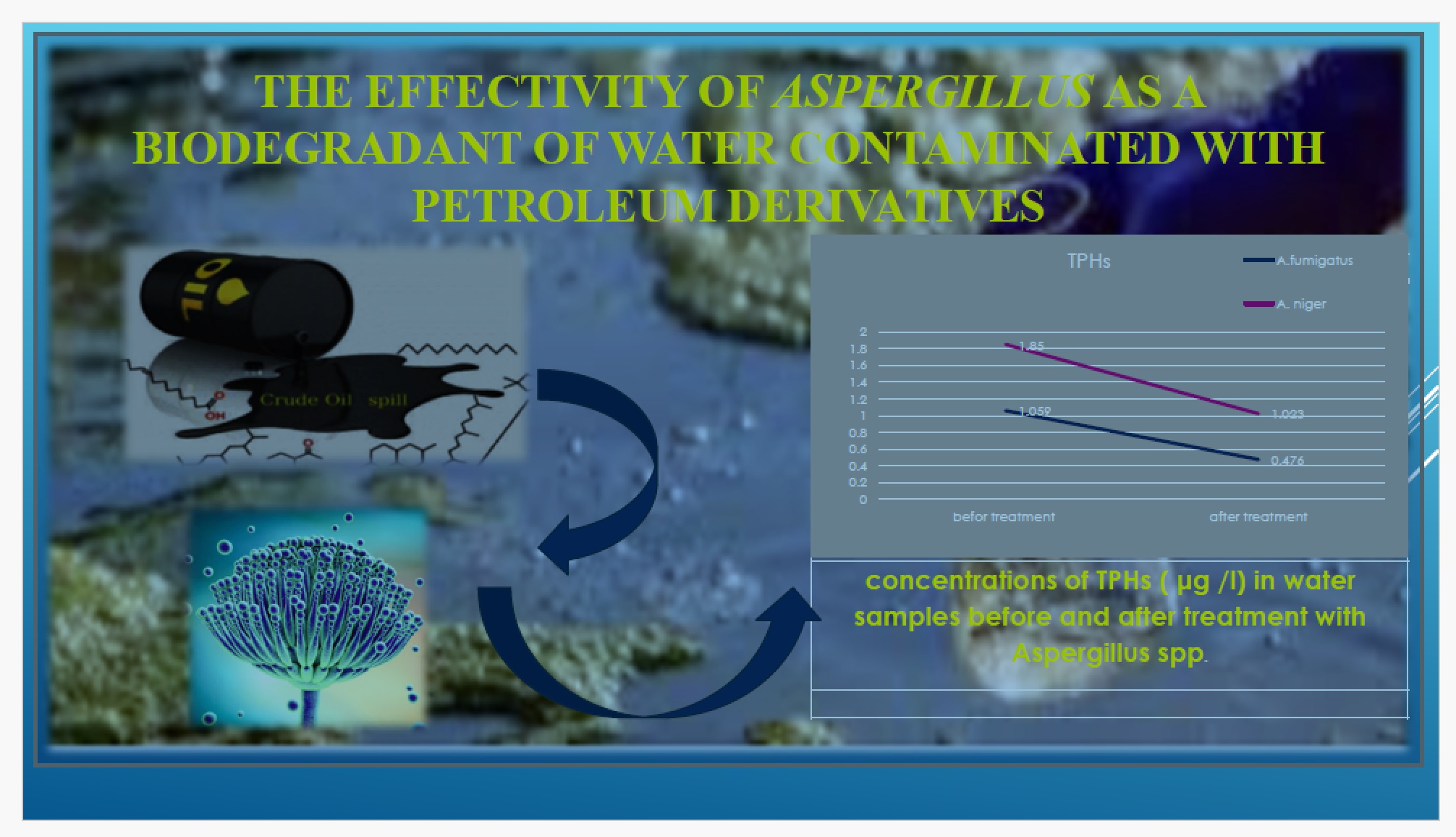
Fungi have attracted increasing attention in biodegradation due to their ability to degrade a wide range of substances through a process known as mycodegradation. This study evaluated that Aspergillus niger has a significant effect in biodegrading contaminated water samples. TPH concentrations in water samples before and after treatment with A. nigar ranged from 1,850 to 1,023 μg/l. TPH removal efficiency reached 44.7% with A. niger and 55.05% with A. fumigatus (from1.059 to 0.476 μg/l). The remaining PAHs were analyzed by GC-MS. The 10 not substituted PAHs on the list of important contaminants (EPA 10 PAHs) were the most frequently analyzed PAHs, with concentrations varying from oil to oil. A. fumigatus showed a higher degree of degradation of PAHs compared to A. niger. Treatment unit containing Aspergillus indicates to be effective in removing heavy metals and improving most physical and chemical properties and nutrients in industrial waste waters analyzed.
References
[1] Zhang, Z.; Hou, Z.; Yang, C.; Ma, C.; Tao, F.; Xu, P.; "Degradation of n-alkanes and polycyclic aromatic hydrocarbons in petroleum by a newly isolated Pseudomonas aeruginosa DQ8". Bioresour. Technol., 102(5): 4111–4116, 2011. https://doi.org/10.1016/j.biortech.2010.12.064
[2] Barnes, N.M.; Khodse, V.B.; Lotlikar, N.P.; Meena, R.M.; Damare, S.R.; "Bioremediation potential of hydrocarbon-utilizing fungi from select marine niches of India". 3 Biotech, 8(1): 21, 2018.
[3] Sardrood, B.P.; Goltapeh, E.M.; Varma, A.; "An Introduction to Bioremediation". In Fungi as Bioremediators, 1st ed.; Goltapeh, E.M., Rezaee Danesh, Y., and Varma, A., Eds.; Springer: Berlin, Germany,3–27, 2013.
[4] Bilen Ozyurek, S.; Avcioglu, N.H.; "The role of Aspergillus parasiticus NRRL:3386 strain on petroleum biodegradation and biosorption processes". Eur. J. Biol., 79(2): 144–150, 2020. https://doi.org/10.26650/EurJBiol.2020.0099
[5] Nji, Q.N.; Babalola, O.O.; Mwanza, M.; "Soil Aspergillus species, pathogenicity and control perspectives". J. Fungi, 9(7): 766, 2023. https://doi.org/10.3390/jof9070766
[6] Spilker, G.; Nugent, N.; "Voluntary carbon market derivatives: Growth, innovation & usage". Borsa Istanbul Rev., 22(Suppl.): S109–118, 2022.
[7] Gall, J.E.; Boyd, R.S.; Rajakaruna, N.; "Transfer of heavy metals through terrestrial food webs: a review". Environ. Monit. Assess., 187: 1–21, 2015.
[8] Abdullah, O.A.; Fathi, R.A.; Fadhel, M.N.; "Use of fungi in bioremediation of contaminated sites with hydrocarbons". Plant Arch., 20(2): 1406–1410, 2020.
[9] Speight, J.G. "Sources and Types of Organic Pollutants". In Environmental Organic Chemistry for Engineers, 1st ed.; Speight, J.G., Ed.; Butterworth-Heinemann: Kidlington, UK, 153–201, 2017.
[10] Aljamali, N.M.; Salih, N.S.; "Review on chemical separation of crude oil and analysis of its components". J. Petro. Eng. Technol., 11(2): 35–49, 2021.
[11] Ambaye, T.G.; Chebbi, A.; Formicola, F.; Prasad, S.; Gomez, F.H.; Franzetti, A.; Vaccari, M.; "Remediation of soil polluted with petroleum hydrocarbons and its reuse for agriculture: Recent progress, challenges, and perspectives". Chemosphere, 293: 133572, 2022. https://doi.org/10.1016/j.chemosphere.2021.133572
[12] Falih, K.T.; Mohd Razali, S.F.; Abdul Maulud, K.N.; Abd Rahman, N.; Abba, S.I.; Yaseen, Z.M.; "Assessment of petroleum contamination in soil, water, and atmosphere: a comprehensive review". Int. J. Enviro. Sci. Technol., 21(13): 8803–8832, 2024.
[13] Hunt, L.J.; Duca, D.; Dan, T.; Knopper, L.D.; "Petroleum hydrocarbon (PHC) uptake in plants: A literature review". Environ. Pollut., 245: 472–484, 2019.
[14] Revill, A.T.; Carr, M.R.; Rowland, S.J.; "Use of oxidative degradation followed by capillary gas chromatography-mass spectrometry and multi-dimensional scaling analysis to fingerprint unresolved complex mixtures of hydrocarbons". J. Chromatogr. A, 589(1–2): 281–286, 1992.
[15] Adeniji, A.O.; Okoh, O.O.; Okoh, A.I. "Analytical Methods for Polycyclic Aromatic Hydrocarbons and Their Global Trend of Distribution in Water and Sediment: A Review". In Recent Insights in Petroleum Science and Engineering; IntechOpen: London, UK, 2017.
[16] Kumari, B.; Singh, S.N.; Singh, D.P. "Biodegradation of Crude Oil by Aspergillus sp. Isolated from Oil-Contaminated Soil in India". J. Exp. Zool. India, 18(Suppl. 1): 13–21, 2015.
[17] Kota, M.F.; Husaini, A.A.; Zulkharnain, A.; Roslan, H.A.; "Bioremediation of crude oil by different fungal genera". Asian J. Plant Biol., 2(1): 11–18, 2014.
[18] Rani, M.H.; Nandana, R.K.; Khatun, A.; Brindha, V.; Midhun, D.; Gowtham, P.; Mani, S.S.; Kumar, S.R.; Aswini, A.; Muthukumar, S.; "Three strategy rules of filamentous fungi in hydrocarbon remediation: An overview". Biodegradation, 35(6): 833–861, 2024.
[19] Yue, Z.; Shi, Q.; Ai, J.; Peng, S.; Miao, X.; Wang, Z. "A Review on Analytical Methods of Petroleum Hydrocarbons in Water and Sediment of Aquatic Systems". In: Proceedings of the 5th International Conference on Energy, Environment and Materials Science (EEMS 2020), Shenzhen, China, July 3–5, 2020; IOP Publishing: Bristol, UK, 2021.
https://doi.org/10.1088/1755-1315/621/1/012011
[20] Ahmed, S.A.; de Hoog, S. "Basic Mycology". In: Diagnosis and Treatment of Fungal Infections, 3rd ed.; Hospenthal, D.R.; Rinaldi, M.G.; Walsh, T.J., Eds.; Springer: Cham, Switzerland, 13–29, 2023
[21] Tamayo-Ordóñez, M.C.; Contreras-Esquivel, J.C.; Ayil-Gutiérrez, B.A.; De la Cruz-Arguijo, E.A.; Tamayo-Ordóñez, F.A.; Ríos-González, L.J.; Tamayo-Ordóñez, Y.J.; "Interspecific evolutionary relationships of alpha-glucuronidase in the genus Aspergillus". Fungal Biol., 125(7): 560–575, 2021.
[22] Richards, L.A. Diagnosis and Improvement of Saline and Alkali Soils. 1st ed.; U.S. Department of Agriculture: Washington, D.C., USA, 1954
[23] Al Imarah F.J.M., Ali S.A., Ali A.A. “Temporal and spatial variations for petroleum hydrocarbons in water and sediments from Northern parts of Shatt Al-Arab River, Iraq”. Mesopotamian J. Mar. Sci., 25(1): 65–74. 2022. https://doi.org/10.58629/mjms.v25i1.211
[24] Vrana, B.; Paschke, A.; Popp, P.; "Polyaromatic hydrocarbon concentrations and patterns in sediments and surface water of the Mansfeld region, Saxony-Anhalt, Germany". J. Environ. Monit., 3(6): 602–609, 2001.
http://www.rsc.org/suppdata/em/b1/b104707h
[25] Beg, M.U.; Gevao, B.; Al-Jandal, N.; Beg, K.R.; Butt, S.A.; Ali, L.N.; Al-Hussaini, M.; "Polycyclic aromatic hydrocarbons in three varieties of fish from Kuwait Bay". Polycycl. Aromat. Compd., 29(2): 75–89, 2009.
https://doi.org/10.1080/10406630902818163
[26] Qiu, Y.W.; Zhang, G.; Liu, G.Q.; Guo, L.L.; Li, X.D.; Wai, O.; "Polycyclic aromatic hydrocarbons (PAHs) in the water column and sediment core of Deep Bay, South China". Estuarine, Coastal Shelf Sci., 83(1): 60–66, 2009.
[27] Barnes, N.M.; Damare, S.R.; Bhatawadekar, V.C.; Garg, A.; Lotlikar, N.P.; "Degradation of crude oil-associated polycyclic aromatic hydrocarbons by marine-derived fungi". 3 Biotech, 13(10): 335, 2023.
https://doi.org/10.1007/s13205-023-03753-2
[28] Al-Dhabaan, F.A.; "Mycoremediation of crude oil contaminated soil by specific fungi isolated from Dhahran in Saudi Arabia". Saudi J. Biol. Sci., 28(1): 73–77, 2021.
[29] Ahmed, Z.A.; Al-Dossary, M.A.; Al-Khatib, F.M.; "Fungal diversity in crude oil-contaminated soils in Basrah province with a preliminary study of its ability to biodegrade crude oil". Intl J Agric Biol, 30 (1): 58–64, 2023.
[30] Cray, J.A.; Bell, A.N.; Bhaganna, P.; Mswaka, A.Y.; Timson, D.J.; Hallsworth, J.E.; "The biology of habitat dominance; can microbes behave as weeds?". Microb. Biotechnol., 6(5): 453–492, 2013.
[31] Krijgsheld, P.; Bleichrodt, R.V.; Van Veluw, G.J.; Wang, F.; Müller, W.H.; Dijksterhuis, J.; Wösten, H.A.; "Development in Aspergillus". Stud. Mycol., 74(1): 1–29, 2013.
[32] Taylor, D.L.; Sinsabaugh, R.L.; "The soil fungi: occurrence, phylogeny, and ecology". Soil Microbiol., Ecol., Biochem., 4: 77–109, 2015.
[33] Minati, M.H.; Mohammed-Ameen, M.K. "Fungal Diversity of Winter Wheat Parts, Seed and Field Soil in Iraq, Basrah Province". In: Proceedings of the 1st International Conference on Engineering and Advanced Technology (ICEAT 2020), Basrah, Iraq, January 15–16, 2020; IOP Publishing: Bristol, UK, 2020. https://doi.org/10.1088/1757-899X/928/6/062004
[34] Premnath, N.; Mohanrasu, K.; Rao, R.G.; Dinesh, G.H.; Prakash, G.S.; Ananthi, V.; Ponnuchamy, K.; Muthusamy, G.; Arun, A.; "A crucial review on polycyclic aromatic hydrocarbons—Environmental occurrence and strategies for microbial degradation". Chemosphere, 280: 130608, 2021.
https://doi.org/10.1016/j.chemosphere.2021.130608
[35] Bokade, P.; Bajaj, A.; "Molecular advances in mycoremediation of polycyclic aromatic hydrocarbons: Exploring fungal–bacterial interactions". J. Basic Microbiol., 63(3–4): 239–256, 2023.
https://doi.org/10.1002/jobm.202200389
[36] Alrumman, S.A.; Standing, D.B.; Paton, G.I.; "Effects of hydrocarbon contamination on soil microbial community and enzyme activity". J. King Saud Univ. – Sci., 27(1): 31–41, 2015.
[37] Hadibarata, T.; Tachibana, S. "Microbial Degradation of Crude Oil by Fungi Pre-Grown on Wood Meal". In: Interdisciplinary Studies on Environmental Chemistry — Environmental Research in Asia, 2 nd ed.; Obayashi, Y.; Isobe, T.; Subramanian, A.; Suzuki, S.; Tanabe, S., Eds.; Terrapub: Tokyo, Japan, pp. 317–322, 2009
[38] Mohsenzadeh, F.; Chehregani Rad, A.; Akbari, M.; "Evaluation of oil removal efficiency and enzymatic activity in some fungal strains for bioremediation of petroleum-polluted soils". Iran. J. Environ. Health Sci. Eng., 9: 1–8, 2012.
[39] Sari, G.L.; Trihadiningrum, Y.; "Petroleum hydrocarbon pollution in soil and surface water by public oil fields in Wonocolo sub-district, Indonesia". J. Ecol. Eng., 19(2): 184–193, 2018.
[40] Vanishree, M.; Thatheyus, A.J.; Ramya, D.; "Biodegradation of petrol using Aspergillus sp.". Int. J. Environ. Sci., 5(5): 914–923, 2014.
[41] Hang, X.; Qi, A.; Wang, P.; Huang, Q.; Zhao, T.; Yan, C.; Yang, L.; Wang, W.; "Spatial distribution, sources, air–soil exchange, and health risks of parent PAHs and derivative-alkylated PAHs in different functional areas of an oilfield area in the Yellow River Delta, North China". Toxics, 11(6): 540, 2023.
https://doi.org/10.3390/toxics11060540
[42] Hadibarata, T.; Kristanti, R.A.; Bilal, M.; Al-Mohaimeed, A.M.; Chen, T.W.; Lam, M.K.; "Microbial degradation and transformation of benzo[a]pyrene by using a white-rot fungus Pleurotus eryngii F032". Chemosphere, 307: 136014, 2022.
https://doi.org/10.1016/j.chemosphere.2022.136014
[43] Alotaibi, F.S.; Alrajhi, A.; Alharbi, S.F.” Bioremediation of high molecular weight polycyclic aromatic hydrocarbons”. In: Microbes Based Approaches for the Management of Hazardous Contaminants,1st ed., Kumar, A.; Shukla, L.; Singh, J.; Ferreira, L.F.R., Eds., John Wiley & Sons: Newark, New Jersey,USA, p. 378–389, 2024.
https://doi:10.1002/9781119851158.ch24
[44] ul Arifeen, M.Z.; Ma, Y.; Wu, T.; Chu, C.; Liu, X.; Jiang, J.; Li, D.; Xue, Y.R.; Liu, C.H.; "Anaerobic biodegradation of polycyclic aromatic hydrocarbons (PAHs) by fungi isolated from anaerobic coal-associated sediments at 2.5 km below the seafloor". Chemosphere, 303: 135062, 2022.
https://doi.org/10.1016/j.chemosphere.2022.135062
[45] Elyamine, A.M.; Kan, J.; Meng, S.; Tao, P.; Wang, H.; Hu, Z.; "Aerobic and anaerobic bacterial and fungal degradation of pyrene: mechanism pathway including biochemical reaction and catabolic genes". Int. J. Mol. Sci., 22(15): 8202, 2021.
Downloads
Published
Issue
Section
License
Copyright (c) 2026 Najwan Abbas Mohammed

This work is licensed under a Creative Commons Attribution 4.0 International License.

.jpg)